Real cloth
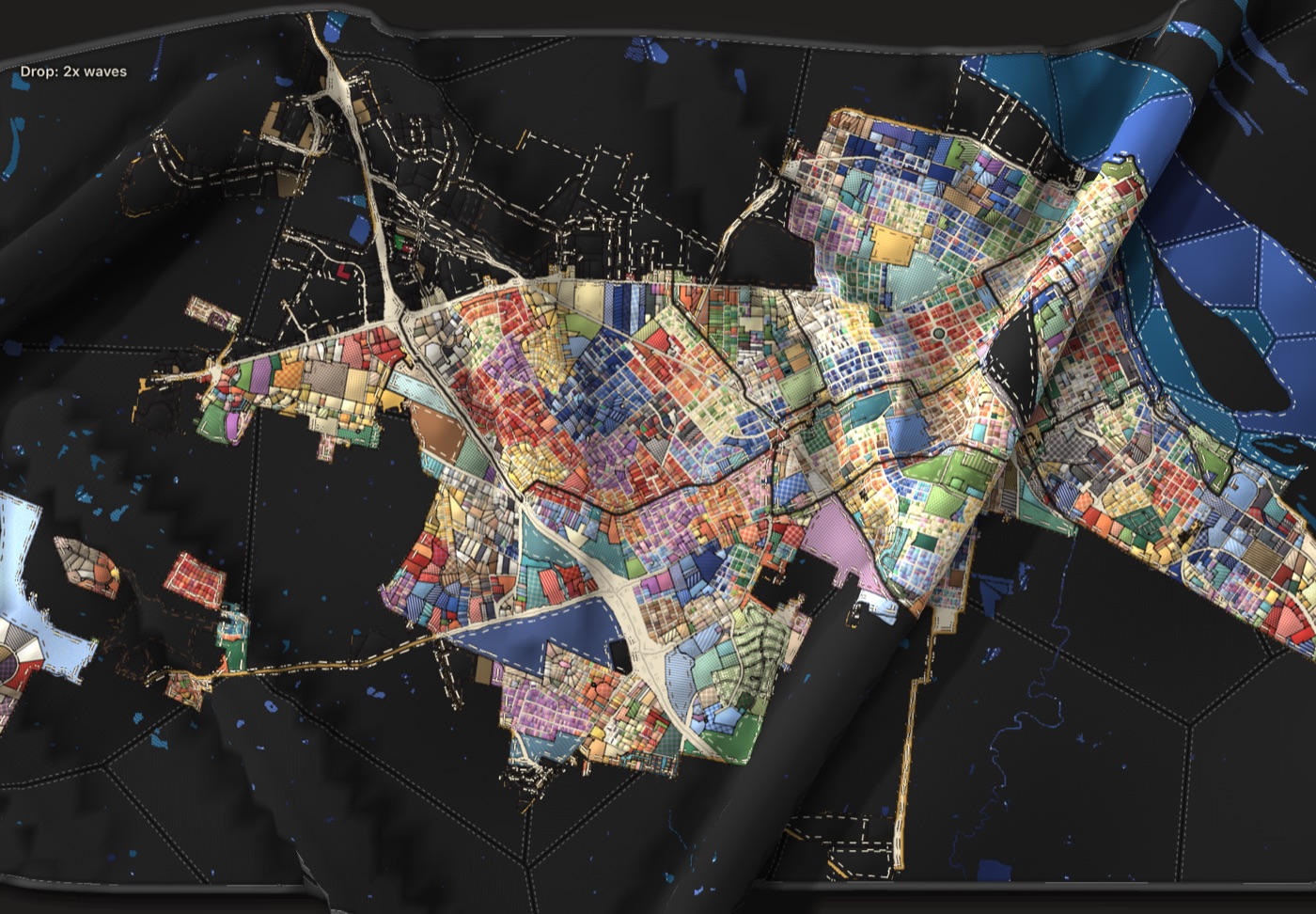
Just after midnight the land around Paducah became a few dark patches so the city could pop. At seven minutes to one, a handoff asked for the quilt as real cloth on the iPad’s glass. At 1:47 it dropped onto an iPad for the first time and settled. By breakfast it folded, hung, cast shadows, had heft, and could be pinned home by its corners.
The sashing
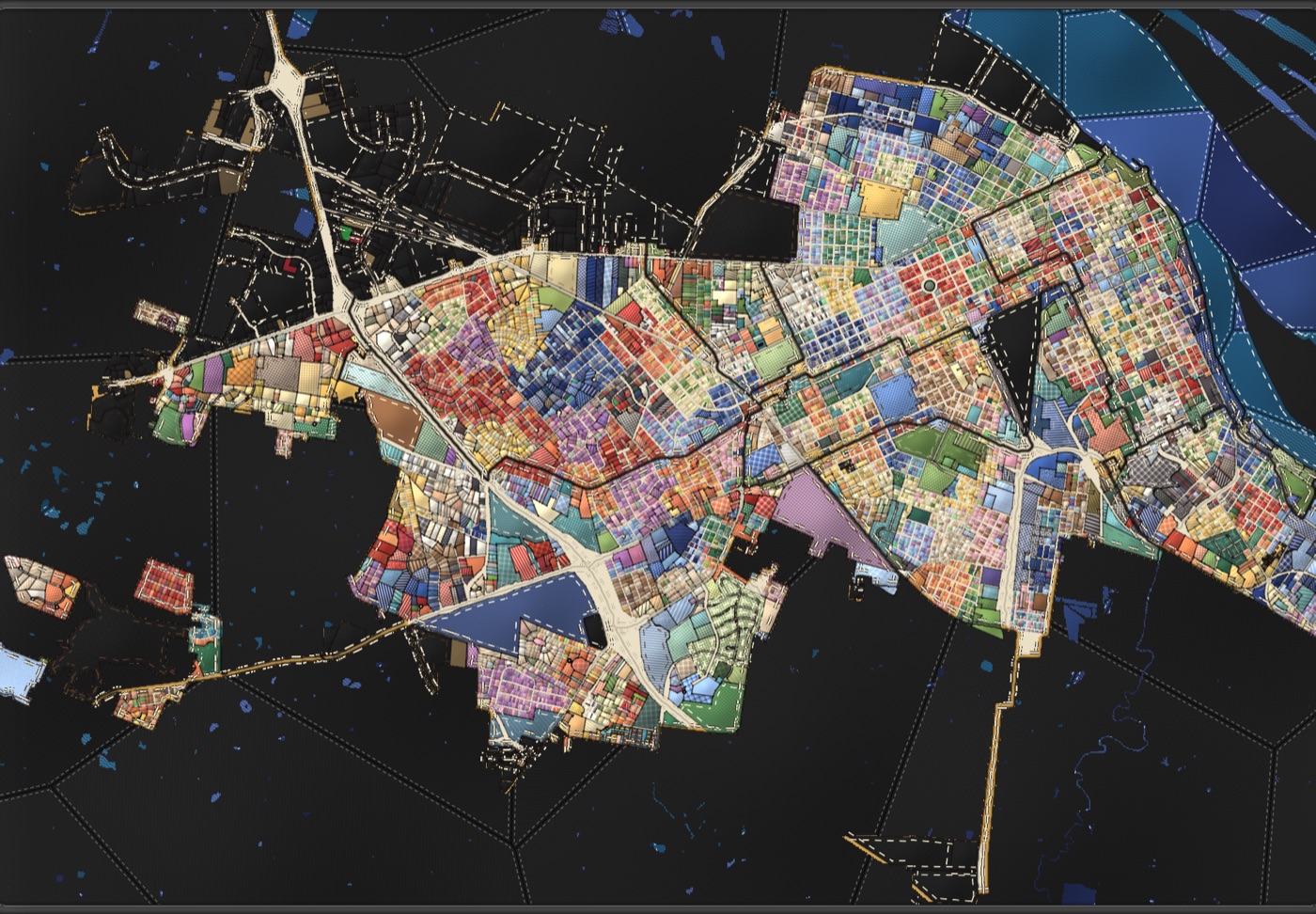
Paducah’s neighborhoods come from the City’s own map, which leaves land around them unassigned: the rivers, the far banks, the fields inside the county line. On a quilt that land is the sashing, the strips between the blocks. At half past midnight it was a dozen named patchworks, each in colors of its own, with everything across the river Illinois. Twenty minutes later the verdict came back that they looked like scales, and the better answer was simpler:
gray patches, just a couple for all the non-city
Oct 3, 00:50
A few big patches of dark gray, the stitching lighter, so the city’s color pops. The twelve areas are still there underneath, kept for the decisions, just not drawn.
The handoff
At seven minutes to one a graphics handoff arrived with two working prototypes: a quilt that falls onto a screen, folds over itself a little and settles almost flat; that hangs like a curtain when the screen stands up; that sloshes when it moves. The ask was to do that with Paducah, on an iPad’s real glass. Within a quarter of an hour it was a plan in the open, with the decisions made: the quilt fitted to the screen, a tap still the way around the city and a drag the cloth, four corners at most, held by magnets, a haptic click when one locks.
you snap the corners into place by just gently correcting the corner placement of the cloth map. subtle bends sell it
Oct 3, 01:10
Overnight
Then good night, and one ask: do as much of it as possible while the house sleeps. The cloth was built in the order the plan set. First the quilt seen through a sheet that bends as gravity turns. Then the cloth itself, written against its tests before it went near the iPad. Then the iPad.
At 1:47 the city dropped onto the glass for the first time: lifted a hand’s height, falling, rippling as it landed, settling with a soft wrinkle or two, then its corners easing home to make it the map again. Nine minutes later the cloth was running on the iPad’s graphics chip, checked frame by frame against the version that had passed its tests. By two it could be picked up under a finger, dragged, and let go near a corner for the magnet to take it.
The morning
At 7:26 the question was whether anything was left undone, and the answer was a list. By half past eight it was done. Folds stack instead of passing through themselves. Shoved, a loose quilt slides on the glass and wrinkles. Stood upright the iPad hangs it like a curtain, its top scooping between two pins; laid back down, the pins let go partway and the quilt falls back onto the glass. It comes in six fabrics, from denim to satin. Turned over, it shows its back. It casts shadows from a light fixed in the room, so tilting the iPad moves them across its folds. Its edge has a binding rolled over it. And a pin button glides all four corners home, however tangled it has got.
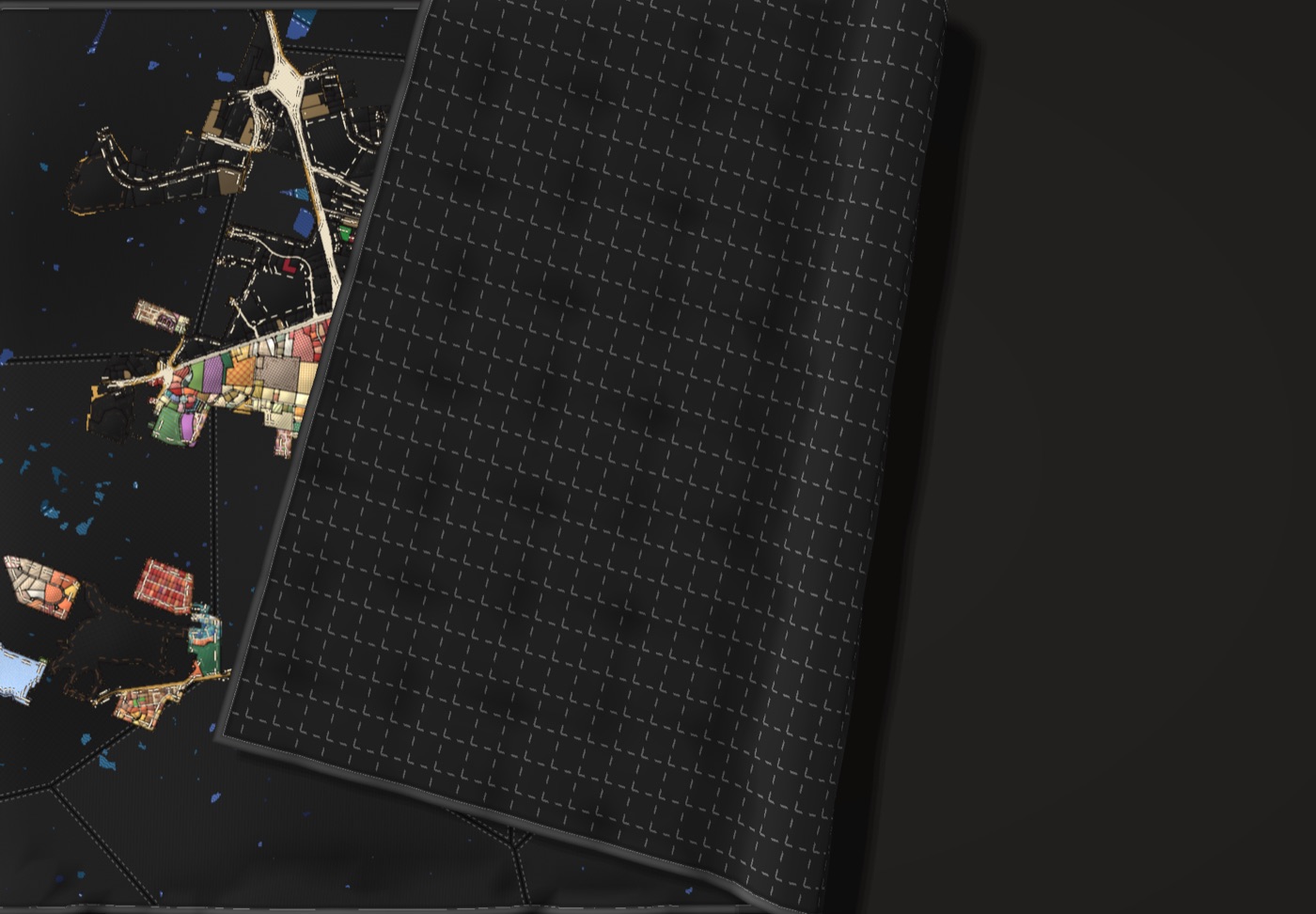
Then the note that made it a quilt and not a sheet:
like it doesn’t just fold like a sheet it has a little heft
Oct 3, 08:10
Now it does: stiffer in a fold, so it rolls instead of creasing; heavier in the air, so it falls rather than floats; and a little thickness, so a fold’s edge shades the layer under it.
A runner, not a stretch
The quilt is wider than an iPad. Stretched to fill the glass, it filled it, and looked stretched. So it keeps its true shape, and its ends hang off the glass and drape over the edge, the way a cloth hangs off a table.
this first one is more of a table runner isn’t it? idk interior design
Oct 3, 08:19
It is, and the tablecloth, hanging off all four sides, is a dial away. As you move around the city the quilt slides under your hands, the overhang coming onto the glass and going off it again, and the magnets hold whatever part of the quilt lies under each corner of the glass.
Tested by hand
The first hands on it found two things inside ten minutes: a fold where the hidden layer showed through, and Downtown not answering a tap after the quilt had landed off-square. Both were fixed within minutes. The folds now stack, and a tap lands on whatever is under the finger, wherever the cloth has put it. A button now reruns the drop with double, full or half waves, named as it falls, so the right amount of drama can be chosen by eye.
Three ways to hold it
By the end of the morning the cloth had its three intents, named. Table: the iPad flat and still, on a desk, which is what was built. Hold: mostly flat, in the hand, never quite still. Hang: upright and still, on a stand or a wall. The iPad can tell them apart by which way is down and by how steady it is.
Puffier, and a pixel’s view
Mid-morning a two-word request arrived: make it puffier. The patches had puffed up in their middles but lay flat at every seam, and a real quilt rises right up out of its stitching. Now the cloth climbs out of every seam, lit on the side that faces the light and shaded on the other. In the same hour a fault that could heap the cloth up on its first drop was found and fixed.
Then the quilt was taught: how a pixel gets its color when a city becomes a quilt, shown in the quilt’s own frames, and told once more by one of its pixels, the one over Lang Park, the circle on Fountain Avenue. To tell it straight, the iPad learned to fold the quilt on cue, a finger that isn’t there drawing Noble Park across the glass, and to say exactly what lies behind any one of its pixels. That turned up two more fixes. A tap on a raised fold now lands on what is drawn there. And the fold put Noble Park behind that pixel, sewn in the sashing’s dark gray, because it sits in none of the City’s neighborhoods. The verdict came back at once: parks are patches, never sashing. Every park in the county now keeps its own cloth.
Then the streets got their names, sewn in a dark thread along the muslin, the names their addresses use. They’re there to help you find your way, not to give directions: they fade in once you’re close enough to read them, and, sewn into the quilt, they fold with it. The map’s open data got its credit in the corner too.
we don’t have to be nav-perfect, we just have to aid orientation
Oct 3, 12:49
One more thing the hand noticed: when you zoomed, every running stitch slid along its seam, which no thread does. Now the stitches stay where they were sewn. Zoom in and new ones appear between them; zoom out and every other one fades away.
The afternoon
By mid-afternoon the morning’s work was on the main line: the cloth, the puffier seams, the street names, the stitches that stay put. Then the hand found the next thing. Lying flat at the landing, the quilt was nailed down at its four corners, and a tug could only stretch it; it had to be whipped to flap.
it should flap immediately from landing if tugged, hard enough to overcome the magnet anyway
Oct 3, 14:30
So the magnets learned to let go. Pull past what a magnet can hold and the corner frees itself with a click, and the quilt flaps from the first tug; pull the loose corner back near its seat and it snaps home. A gentle tug keeps all four corners; a hard one takes two; a second hand pulling the corner back ends with all four home and the quilt flat. The rest of the magnetic feel, four named magnets and a pair at each, one on the glass and one in the cloth, red and blue, is written down for the next days.
And the quilt got its label, embroidered on its far north-west corner where a quilter would sign it: Welcome to Paducah, from Fork Development Corp, and the map’s open data credited beneath. It lies a mile off the glass to the left, and the plan for the opening is to hold on it, close, and then let that corner fall away over the Mall’s magnet until the city is all that’s left.
That corner got a name, the tag-corner, and a second face: turn it over and there’s a leather tag, grained and saddle-stitched, with a word pressed into it. The label itself went through four tries before its letters read as thread rather than ink: satin crowns that catch the light, pale against the navy between them, each letter standing a little proud of the muslin. Every try was kept, with its frame, for the shimmer still to come.
the text should probably look like quilting, like embroidery or something
Oct 3, 15:40
The evening
The label went through eight tries before it read as thread. Satin, stem stitch, a Scout patch’s fill: each one shaded dark thread on dark thread and came out looking printed. Cross-stitch broke the spell, one X for every square of the quilt, because its texture is its structure. Turned a quarter turn to run down the quilt’s west end, it had room for all three lines; at half the size it leaves the rest of that end for the city, and a second layout runs it all the way across the top with the city’s patches sewn over it.
i was doing this in boy scouts
Oct 3, 16:49
The opening found its shape by being thrown out twice. A held card with a tap to release felt staged; a fold across the whole west felt forced. What stayed is a quilt flopped onto the table with one corner turned over on the diagonal, the leather tag at a slant on the city, and nothing to do but flick it closed. The corner wanted to unfold itself, because a quilt stays folded by its weight and the table’s grip, and the cloth here has neither; so its tip is held until the flick. The magnets learned to pull harder, the drag learned not to outrun the cloth, and the pinch learned to zoom about what’s drawn under the fingers, not where the cloth lay flat.
Two trips were planned for later, and one of them left the same night. Six iPads taped into a box, each a window into one shared volume, stays a plan. The Blow mode was built: the quilt hoisted along its west edge as a flag, in a wind that pushes on each face by how hard it blows across it, with flutter from a gust field drifting downwind, and a breath on the microphone as the wind. It was first built the way it was described, the whole quilt frozen in the room while the iPad turned around it, and that misfired twice: a lifted cloth flew through the eye of the camera, and a flag whose plane turns away from the glass is a flag seen edge-on. So the flag lives in the glass, gravity is live from the sensor (tip the iPad up and it hangs from its pole), and only the wind is held in the room, turning over the flag as the iPad turns.
i’d think i could turn the ipad to let the thing hang y’know
Oct 3, 17:20
Then the flag wouldn’t fly. It slumped against its pole in a bundle sixty rows thick, because a flag lying in its own plane feels no push from a wind along it; what flies a real flag is the drag its own flutter makes. The carry along the cloth was raised until a light breeze lifts it, and it streamed across the glass. The pin button brings the wind down and plays the flip. A quick pull toward you and push away lifts the quilt off the glass, a breath of its own.
The snowflake button freezes any state in the room: the quilt stays where it is while the glass turns around it. Its first version turned the quilt about the glass’s own middle, so a turn only collapsed it edge-on (“it seemed to warp into it”); turned about the eye instead, a small turn panned it off the glass. The iPad in a hand pivots a few inches behind the glass, and that is where it pivots now, a dial for the owner’s hand. The label grew a fourth line of thanks and its cross-stitch doubled its count so the small lines could be read; the quilt’s binding was the last thread whose stitch crawled with the zoom, and it was put on the ladder with the rest. By the end of the evening the day’s six branches were on the main line, in order, one at a time, and a seventh mode was written down for later: the iPad tossed onto a table, the quilt sliding with the throw.
The county went on the back in its real shape: the county line stitched round, the Ohio and the Tennessee in the river patch’s navy, six places as pieces grown from their outlines and their points by the same walk that cuts the sashing, and the city in the middle pieced into its parts. And a rule was written down for the magnets, for a day to come: never snap. A magnet is a soft pull that firms up as the corner arrives and lets go when pulled past its strength; the quilt always finds its own way to where it needs to be.
What’s next
Hold and hang, as their details come. The touch, judged by hand: how far a magnet reaches, how quickly it draws a corner in, whether a drag and a pinch ever argue. The quilt’s sewing, its opening and its voice on the iPhone and iPad. And the App Store, which still waits on the paid team.
- The sashing: a dozen named patchworks, Illinois across the river.
- The sashing: a few dark gray patches, so the city pops.
- The cloth handoff arrives, with two prototypes.
- Fitted to the screen, tap to go, drag for cloth, magnetic corners.
- The quilt through a sheet that bends with gravity.
- The cloth, written against its tests.
- The first drop onto the glass.
- The cloth on the iPad’s graphics chip, checked frame by frame.
- Grab, drag, and the magnetic corners.
- Folds that stack instead of passing through.
- Slosh, the curtain, six fabrics, a drop button.
- Shadows from a light fixed in the room.
- The pin button: all four corners home.
- Heft, a little depth, the back in dark gray.
- True shape: a runner, its ends hanging off.
- A tap lands on what’s under the finger.
- Double, full and half waves.
- Puffier: the cloth rises out of every seam.
- The heap on a first drop, fixed.
- How a pixel gets its color, taught on the quilt.
- The quilt folds on cue, and says what lies behind a pixel.
- A tap on a raised fold lands on what’s drawn there.
- Parks are patches, never sashing.
- The map's open data credited, in the corner.
- Street names, sewn along the streets.
- Threads that stay put when you zoom.
- The morning’s work on the main line.
- Breakaway and catch: a tug frees a corner, a pull back snaps it home.
- The quilt’s label, on its north-west corner.
- The tag-corner: satin that catches the light, and a leather tag on its underside.
- The stitches stay put when you zoom; a tug frees a corner; the pinch zooms on what’s drawn.
- Cross-stitch, turned down the west end: the label reads as thread.
- The opening: flopped onto the table, one corner turned over, flick it closed.
- Blow mode and the six-iPad box, written down for later.
- The wind, the hoist, and a breath on the microphone.
- The flag lives in the glass; the wind lives in the room.
- Never snap: the magnets as soft pulls, written down.
- The county on the back, in its real shape.
- The carry that flies a flag; the pin button brings it down and plays the flip.
- A pull and a push: the quilt breathes off the glass.
- The snowflake: frozen in the room, the glass a window.
- The six branches merged to the main line, in order.
- Four lines on the label, two Xs to a cell; the binding’s stitch on the ladder.
- Drop mode: the toss, written down.